
Diamond Bearing Material
Polycrystalline diamond is known for its high thermal conductivity, low coefficient of friction, high toughness and other preferred physical and mechanical properties. Having a bearing material with high thermal conductivity reduces localized temperature extremes that lead to bearing degradation. During starting and stopping, a high thermal conductivity will reduce the likelihood of causing localized welding of the surfaces, which in turn leads to scoring and galling of the bearing surface. In sliding bearings, low coefficients of friction are desired in order to decrease heat generation and reduce power loses. A bearing material exhibiting a large fracture toughness will decrease the likelihood of race damage during extreme operation conditions. Because of its extreme hardness, polycrystalline diamond is very resistant to wear from abrasive particles in lubricants or process fluids.
| Properties | Polycrystalline Diamond (PCD) | Tungsten Carbide | Steel (4140) | Silicon Nitride | Silicon Carbide |
|---|---|---|---|---|---|
| Coefficient of Friction | 0.05-0.08** | 0.2-0.25† | 0.42‡ | — | — |
| Thermal Conductivity (W/m*K) | 543 | 70 | 42.6 | 30 | 85 |
| Fracture Toughness (MPa√m) | 13-15 | 10-25 | 50 | 4 | 3.5-4 |
| Hardness (GPa, Knoop) | 49.8 | 1.8 | 0.2 | 1.8 | 2.4 |
| Compressive Strength (GPa) | 6.9-7.6 | 2.68 | — | — | 2.5 |
| Young’s Modulus (GPa) | 841 | 669-696 | 205 | 296 | 434 |
| Tensile Strength (MPa) | 1,300-1,600 | 334 | 415 | 520 | 500 |
*ASI 4140 Steel, annealed at 815°C (1500°F) furnace cooled 11°C (20°F)/hour to 665°C (1230°F), air cooled, 25 mm (1 in.) roun(1100°F) temper)
** PCD on PCD in H2O, dynamic, dynamic
†Tungsten Carbide on Tungsten Carbide, static
‡Steel (Hard) on Steel (Hard), dynamic
YAt 100˚C
Sources: Bertagnolli, US Synthetic; Roberts et al., De Beers; Cooley, US Synthetic; Jiang Qian, US Synthetic; Glowka, SNL; Sexton, US Synthetic; Lin, UC Berkeley, MatWeb.com, Cerco
Fracture Toughness
(MPa√m)
- PCD Diamond
- Tungsten Carbide
- PCBN
- Silicon Nitride
- PCD Diamond
- Tungsten Carbide
- PCBN
- Silicon Nitride
Hardness
(GPa, Knoop)
- PCD Diamond
- CBN
- Silicon Carbide
- Tungsten Carbide
- Silicon Nitride
- Silicon Oxide
- PCD Diamond
- CBN
- Silicon Carbide
- Tungsten Carbide
- Silicon Nitride
- Silicon Oxide
Coefficient of Friction
(smaller number signifies lower friction)
- PCD Diamond
- Tungsten Carbide
- Steel
- PCD Diamond
- Tungsten Carbide
- Steel
Thermal Conductivity
(W/m*K )
- PCD Diamond
- Copper
- Silicon Carbide
- Tungsten Carbide
- Steel
- Silicon Nitride
- PCD Diamond
- Copper
- Silicon Carbide
- Tungsten Carbide
- Steel
- Silicon Nitride
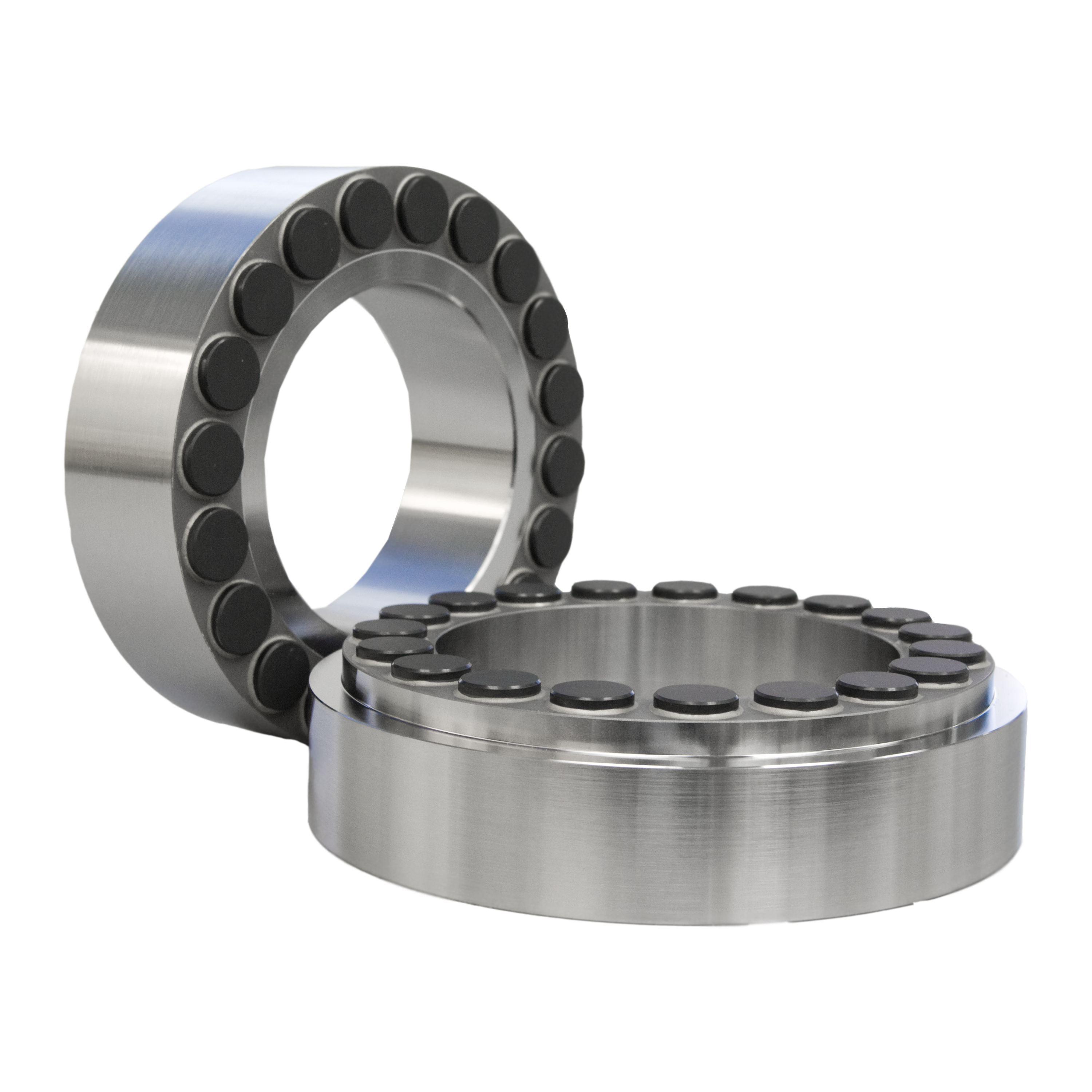
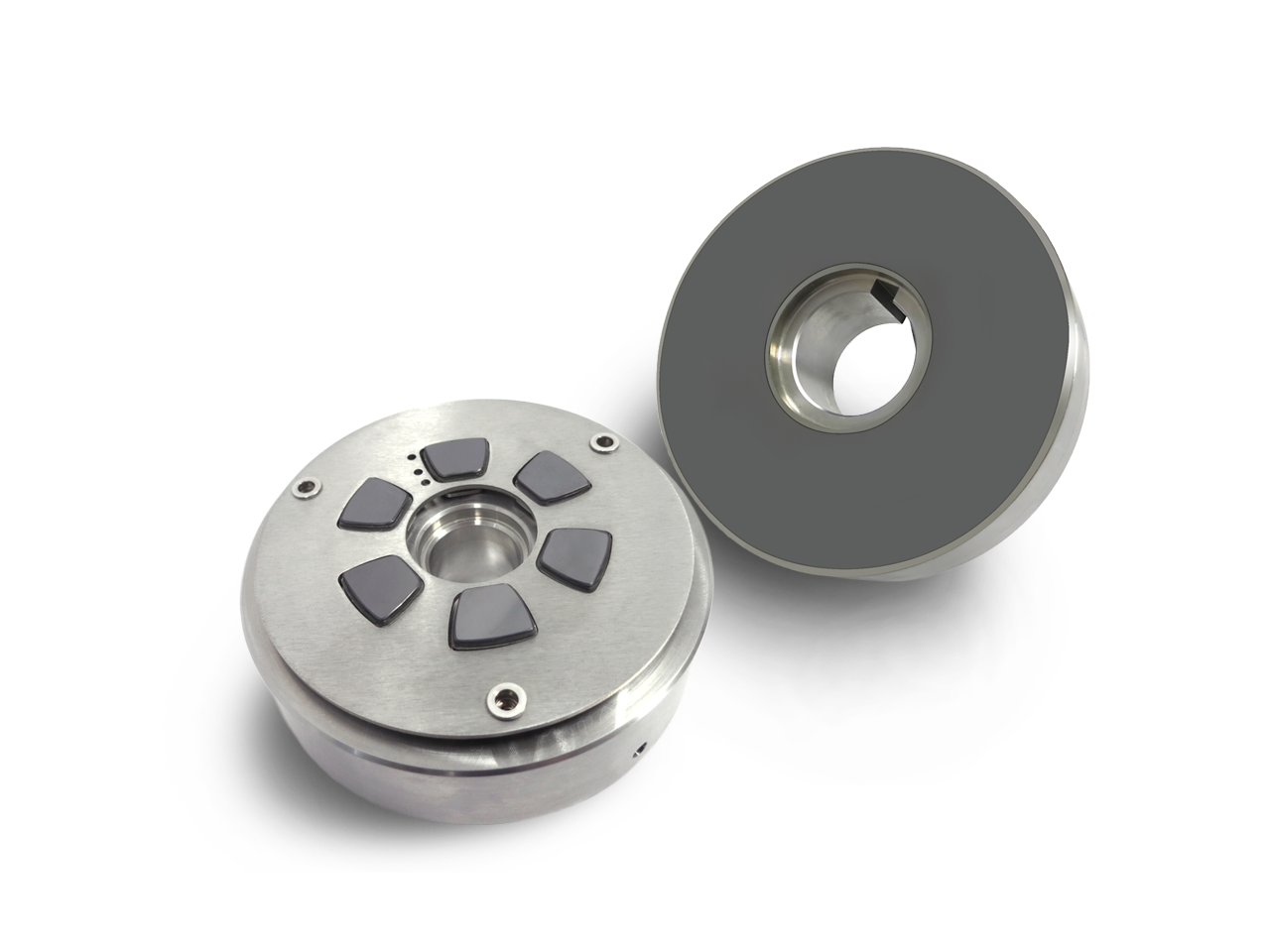
Diamond bearings utilize Polycrystalline diamond (PCD) in their primary working surfaces. In general, bearings allow relative movement or rotation of two machine elements with respect to one another while minimizing heat generation and maintaining alignment between the respective machine elements. There are several classes of bearings. Three of the most common would be rolling element, sliding and fluid film bearings.

Rolling element bearings
accommodate relative motion by inserting a rolling element between the races that move relative to one another.

Sliding bearings
use special bearing materials that work well together as sliding parts to reduce friction and thus reducing heat and wear. These bearings are operated with and without lubricants.

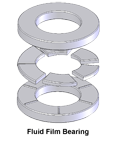
Fluid film bearings
comprise two surfaces moving with respect to one another in the presence of a fluid lubricant that separates the surfaces. The speed of the relative motion, the viscosity of the fluid, and the geometry of the bearings work together to create the fluid film. The fluid film keeps the friction and heat generation to a minimum and makes wear non-existent as long as the surfaces remain separated. A crankshaft in an automobile is an example of this.
Polycrystalline diamond could, in principle, be used in all three bearing types. Currently, however, they are found in only sliding and fluid film bearings. Diamond bearings consist of precision machined polycrystalline diamond surfaces that run relative one to another. In operation diamond bearings may act as dry sliding bearings with little or no lubricant, semi-lubricated sliding bearings or fully lubricated fluid film bearings.
Because of the properties of polycrystalline diamond, diamond bearings are capable of operating under harsh conditions which include operating with process fluids and severe loading. They are extremely resistant to abrasion and provide bearing lives that are 2 to 8 times longer than tungsten carbide or other hard metal bearings when operating in abrasive fluids. Successful applications include the near-bit bearing set in drilling mud motors and turbines. In these applications, bearing life has been extended, overall tool length has been shortened and bearing reliability improved. Diamond bearings have also found application in power generation and rotary steerable tools where bearing life has been at least tripled when compared to conventional tungsten carbide bearings. The outstanding toughness, thermal conductivity and hardness are the main properties of polycrystalline diamond that make it such an outstanding bearing material.
Characteristics of common classes of bearings:
| Fluid Film | Sliding | Rolling Element | |
|---|---|---|---|
| Startup Friction | 0.25 | 0.1-0.15 | 0.002 |
| Running Friction | 0.001 | 0.05-0.1 | 0.001 |
| Velocity Limit | High | Low | Medium |
| Load Limit | High | Low | High |
| Life Limit | Unlimited | Wear | Fatigue |
| Lubrication requirements | High | Low/None | Low |
| High Temperature Limit | Lubricant | Material/Lubricant | Lubricant |
| Cost | High | Low | Medium |
reference with permission: Khonsari and Booser, Applied Tribology, Bearing Design and Lubrication, John Wiley and Sons, 2008
Tribology comes from the Greek word ‘tribos’ which means ‘rubbing’. It is a relatively new science that considers the friction, wear and lubrication at moving contacts. Diamond bearing tribology looks at the physics between two diamond surfaces moving relative to one another, most of the time in the presence of a lubricant.

A magnified view of even the most smoothly machined or ground surfaces will reveal a rough looking surface with high asperities and low valleys. Please refer to figure 1. Two surfaces in sliding motion will contact first at these high asperities. It is the action of welding and shearing that takes place on this uneven surface that results in what we understand as friction. This is largely independent of surface area as first described by
Guillaume Amontons (1699).
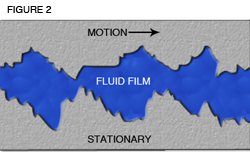
As speed increases with the right bearing geometry and lubricant viscosity, a pressurized fluid film can develop between the two surfaces. This film supports the load and keeps the two surfaces completely separated as shown in figure 2. Under these conditions, friction and heat generation are greatly reduced and bearing wear is virtually eliminated. Compare common characteristics of bearing material.
While decreasing the speed, a point is reached where there is not enough relative velocity to maintain pressure in the fluid film and the gap between the two moving surfaces breaks down. Asperities contact, heat and shearing occur and friction increases.
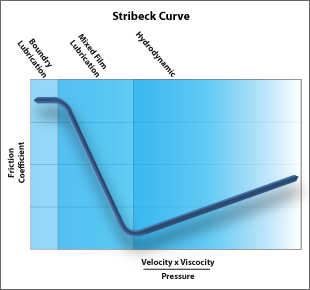
These lubrication regimes are evident in the Stribeck dimensionless curve where friction coefficient, is plotted against absolute viscosity, rotational speed and unit load,. Three identifiable lubrication regions are illustrated in the Stribeck Curve graph: boundary lubrication, mixed and fluid film.
Diamond bearings have the advantage that they can operate effectively in both the fluid film and mixed lubrication regions.
Performance of diamond bearings for boundary, mixed-mode and hydrodynamic lubrication regimes
Extreme operating and environmental conditions, such as high and varying load, high temperature, high or varying speed, and less than ideal lubricating fluids can cause excessive wear, damage, and even failure in conventional thrust bearings. This paper discusses the advantages of polycrystalline diamond (PCD) bearings operating in boundary, mixed-mode and hydrodynamic lubrication regimes.
Analysis of diamond segmented pads on rotating and stationary bearings in contact sliding
Polycrystalline diamond (PCD) bearings are designed for severe conditions where contaminated fluids, high and varying loads and speeds, and elevated temperatures cause failure in machine components.
Polycrystalline diamond thrust bearings for down-hole oil and gas drilling tools
Down-hole tools used for drilling oil and gas wells are subjected to harsh environments where abrasive fluids, high loads and speeds, and high temperatures can cause tool components, including thrust bearings, to quickly fail. This paper discusses the advantages that polycrystalline diamond can provide when used as a bearing material in down-hole tools.
Wear-in behavior of polycrystalline diamond thrust bearings
Polycrystalline diamond (PCD) bearings are designed for use in harsh environments, including process-fluid-lubricated applications such as those in oil and gas drilling turbines.
The development of open water-lubricated PCD thrust bearings for marine hydrokinetic energy machines
The Development of Open Water-lubricated Polycrystalline Diamond (PCD) Thrust Bearings for Use in Marine Hydrokinetic (MHK) Energy MachinesA polycrystalline diamond (PCD) bearing has been developed that will operate successfully in Marine Hydrokinetic (MHK) machine applications. PCD bearings represent a new class of bearings that have, heretofore, not been extensively studied. This work makes significant contributions … Continue reading The development of open water-lubricated PCD thrust bearings for marine hydrokinetic energy machines
Seven Steps to Reducing Failure and Cycle Time
The manufacturing team was looking for a way to reduce the time required to make the cutters. The reason for the cutter failures needed to be determined of frequency and manufacturing time were to be reduced.
The Role of Diamond Surface and Intrinsic Contaminates on Sintering of Polycrystalline Diamond Compacts (PDC)
High pressure/high-temperature sintering of polycrystalline diamond compacts (PDC) is sensitive to impurities in the diamond feedstock, both surface and intrinsic.
Effects of Design and Processing Parameters on Performance of PDC Drag Cutters for Hard-Rock Drilling
Sandia National Laboratories and U S Synthetic Corporation have jointly conducted a multifaceted, baseline experimental study to support the development of improved drag cutters for advanced drill bits.
Polycrystalline Diamond Compact (PDC) Design Methodology Utilizing Strain Energy Capacity
PDC bits have had limited success at drilling high compressive strength and abrasive rock formations. One of the limitations to hard rock drilling is the propensity of the cutters to fracture.
Understanding and controlling residual stresses in thick polycrystalline diamond cutters for enhanced durability
Residual stresses in PDC cutters arise from the difference in thermal expansion between the polycrystalline diamond layer and the supporting tungsten carbide substrate after sintering at high pressure and temperature. If not managed correctly, these stresses can significantly reduce the toughness of the cutters, especially as the diamond-layer thickness increases.